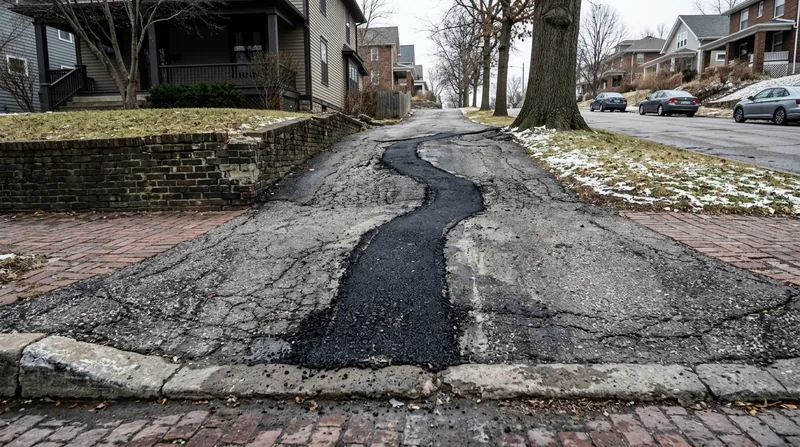




Driveway Repair in Omaha means cutting out the failed section, rebuilding the base, and patching with hot mix asphalt so the repair holds through the next Nebraska winter. Omaha's driveways crack where freeze-thaw cycles work on bases built for the 42-inch frost line, and where the loess and glacial till underneath the slab hold water against the pavement year round. The hilly, early-1900s streetcar neighborhoods around the Old Market sit on sloped streets cut into deep wind-blown loess, while the mid-century ranch belt and newer subdivisions pushing west toward Elkhorn face the same frost heave, edge failure, and washouts that come with plow blades and meltwater every season. When a driveway shows alligator cracking, settlement, or edge spalling, a repair that addresses the base and removes the compromised asphalt is almost always the right move before the damage spreads. We cut out the failed section, rebuild the loess and till base with compacted aggregate, and patch with hot mix so the repair holds through the next cycle of freeze, thaw, and snow.
Why Driveway Repair Matters in Omaha's Freeze-Thaw Climate
Omaha's extreme seasonal swings create the conditions where driveway failure happens fast. Freeze-thaw cycles heave slabs where the base wasn't built deep enough or compacted properly for the 42-inch frost line, and plow blades take their toll on aprons and edges every winter. Water sits under asphalt that has no pitch, and once it freezes, it lifts the slab. Alligator cracking spreads across the surface when the base loses strength, and edge failure opens the door to washouts that undermine the entire drive.
- We remove the failed asphalt section and inspect the base for saturation and frost heave.
- We rebuild the loess and till base with compacted aggregate sized for the 42-inch frost depth.
- We patch with hot mix asphalt, compacted and finished to slope water away from the slab.
- The repair is sized to stop the failure from spreading into sound pavement.
A repair that addresses the base and removes the compromised asphalt is the honest choice when 20 to 30 percent of the driveway has failed, and it costs far less than waiting for the damage to spread across the whole surface.
Key info: In Omaha's older neighborhoods like the bluffs above the Missouri River and the mid-century ranch belt, driveways built on sloped loess and clay-rich till answer to the same freeze-thaw damage every winter. A patch that rebuilds the base holds, but an overlay that skips base repair will fail again within two seasons.
For more information on when to patch versus when to resurface, see our Asphalt Resurfacing and Overlay page.
How We Repair Driveways in Omaha: The Step-by-Step Process
A driveway repair starts with a clear assessment of the failed section and the base condition underneath. We measure the area, identify whether the failure is surface cracking, edge spalling, settlement, or base saturation, and determine whether the repair will hold or whether the section needs to be rebuilt from the base up. Once the scope is clear, we cut out the failed asphalt, prepare the base, and patch with hot mix compacted to the same density and thickness as the original.
- We cut the failed asphalt section with clean, straight edges so the new patch bonds to sound pavement on all sides.
- We remove the cut-out material and inspect the base for water, soft spots, and frost heave.
- We compact the base with aggregate, adding material if needed to match the original grade and frost depth.
- We heat the edges of the remaining asphalt so the new hot mix bonds without a cold seam.
- We place hot mix asphalt into the cut, compact it, and finish it to match the surrounding surface slope.
The repair is complete and ready for traffic once the asphalt cools, usually within a few hours in cool weather and by the next morning in hot weather.
Example: A Papillion homeowner noticed alligator cracking across the center of the driveway where the loess base had settled and held water. We cut out a 12-by-16-foot section, rebuilt the base with compacted aggregate, and patched with hot mix. The repair held through the next two winters because the base was addressed, not just the surface.
For more detail on pothole and full-depth patching methods, see Pothole Repair and Asphalt Patching.
| Repair Approach | Description | Best For |
|---|---|---|
| Pothole or Shallow Patch | Cut out the failed asphalt, compact the base, and fill with hot mix to match the surrounding surface. | Single potholes or surface-only failures smaller than 50 square feet. |
| Full-Depth Patch | Remove all failed asphalt and rebuild the base with compacted aggregate to the frost depth before patching. | Alligator cracking, settlement, edge failure, or any patch larger than 50 square feet where the base is compromised. |
| Resurfacing (Overlay) | Mill or clean the existing surface and apply a new layer of hot mix asphalt over the top. | Cracks and minor wear across 30 to 40 percent of the driveway, only if the base is sound and not heaving. |
| Full Replacement | Remove all asphalt and base, mill the subgrade, compact new base to frost depth, and pave with new hot mix. | More than 40 percent of the driveway failed, extensive heaving, or base failure that patches cannot address. |
Driveway Repair Cost in Omaha: What to Expect
Driveway repair costs in Omaha depend on the size of the failed section, the condition of the base, and whether the patch is shallow or full-depth. A single pothole or small surface crack patch can start at $450 to $800, while a larger full-depth patch that includes base rebuild can run $1,200 to $2,500 depending on the square footage and the depth of base work needed. A driveway with extensive alligator cracking across 40 percent or more of the surface usually costs less to resurface or replace than to patch multiple sections, and that decision depends on a site visit and written estimate.
The factors that move the cost are the size of the failed section, whether the base is soft or saturated and needs rebuild, and whether the repair is in the center of the drive or at an edge where washout is happening. A repair on a sloped lot in the Old Market or Dundee neighborhood may cost more if the base is deep loess that has lost strength, while a repair on a newer driveway in west Omaha or Gretna may be less complex if the base is newer and better compacted.
We provide a free written estimate with tonnage specs and a clear scope of work so you know exactly what the repair will cost before we start. Call us at (402) 807-2119 to schedule an on-site look, or visit our pricing page for typical ranges across all our services.
Driveway Repair Near Me: What to Look for When Hiring a Contractor in Omaha
Hiring the right asphalt contractor means verifying that the company is local, insured, and willing to explain the work in writing before the job starts. The strongest trust signal in this trade is being verifiably local with a local address and local plates, because the historic fraud in driveway paving is the itinerant door-to-door crew that shows up unsolicited, offers leftover asphalt from a nearby job, asks for a large cash deposit, and disappears. An honest contractor will give you a written estimate with the scope of work, the tonnage of asphalt, the depth of base work, and the cost broken down so you can compare to other bids.
Before you hire, check that the contractor carries liability insurance and is fully insured. In Nebraska, state law requires every contractor to register with the Department of Labor before performing construction work, which is a registration of identity and proof of insurance, not an examined license. If your driveway apron meets the street right-of-way, the City of Omaha or your village may require a permit before the work starts, so ask the contractor whether a permit is needed for your address and whether they can help you navigate local permitting. Some neighborhoods and HOA communities have architectural standards that govern driveway material and extensions, so verify those rules before you commit to a scope.
Get at least two to three written estimates so you can compare the scope, the tonnage, the base work, and the price. An estimate that is too good to be true, or one with no tonnage or depth specs, is a red flag. Call us at (402) 807-2119 for a free estimate, and we will walk you through the work and answer any questions you have about the repair.
Driveway Repair in Omaha: Pricing Guide
| Service | Price | Details |
|---|---|---|
| Small pothole or surface patch | Starting at $450 | Single pothole or shallow failure under 50 square feet, asphalt removal and compaction included |
| Full-depth patch with base rebuild | Starting at $1,200 | 50 to 150 square feet, includes base inspection, aggregate, compaction, and hot mix placement |
| Large patch or multiple sections | Starting at $2,000 | 150 to 300 square feet, alligator cracking or extensive edge failure requiring base work across multiple areas |
| Extensive failure or full resurfacing | On estimate | More than 300 square feet or 30 to 40 percent of driveway failed, requires site visit to assess base and recommend patch versus overlay versus replacement |
| Travel within Omaha service area | Included | No separate mileage fee or call-out charge in Omaha, Papillion, Bellevue, La Vista, and surrounding Greater Omaha communities |
| Free written estimate | No charge | Response within 24 hours, includes scope of work, tonnage specs, and pricing breakdown, no obligation to book |
Indicative pricing, the exact cost depends on square footage, finish, and site access. Free personalized estimate within 24h at (402) 807-2119.


