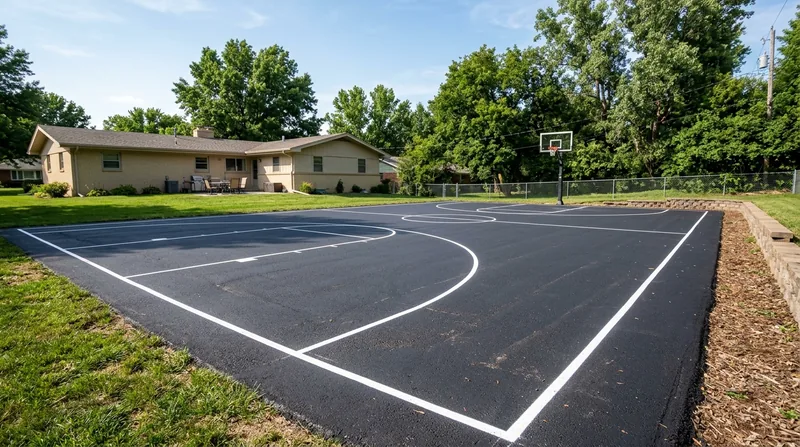




Sports Court & Path Paving in Omaha demands a foundation built to survive the plains freeze-thaw cycle. Omaha's summer storms drop water fast, and Nebraska's 42-inch frost line means any base that isn't compacted deep enough heaves and cracks when winter hits. A backyard basketball or tennis court needs hot mix asphalt laid over a properly prepared aggregate base, pitched to shed water quickly, and finished smooth enough for real play. We compact the base past frost depth, pave hot mix with an even surface, and grade it to drain fast after the thunderstorms that roll through in June and July. The difference between a court that plays true for a decade and one that crazes and fails in three years is the work done before the asphalt truck arrives.
Why Sports Court & Path Paving Matters in Omaha's Freeze-Thaw Climate
Omaha sits on deep wind-blown loess over clay-rich glacial till that holds water year-round. That moisture moves up under asphalt in winter, freezes, heaves the slab, and opens cracks that water then exploits in spring melt. A backyard court built on a shallow or poorly compacted base fails in two or three seasons. A court built to handle the frost depth and pitched correctly can play for ten years or more. The cost difference between doing it right and doing it cheap is paid back in years of use.
- Frost heave cracks asphalt when water freezes under a shallow or soft base, and Omaha's 42-inch frost line means base preparation cannot be skipped.
- Summer storms in Greater Omaha dump water fast, so pitch and drainage away from the court surface are critical to prevent ponding and accelerated surface failure.
- Hot mix asphalt cures properly only when laid and compacted in warm, dry conditions, making spring through early fall the ideal window for new court paving.
- A smooth, even surface is non-negotiable for tennis and basketball, and achieving that requires skilled finishing and proper equipment.
Getting the base right and the surface smooth is the difference between a court that works and money wasted on repairs.
Key info: The City of Omaha and suburban municipalities in Douglas and Sarpy counties regulate impervious-surface limits and drainage for residential construction. Check with your local building department before planning a new court, and verify any HOA architectural standards that may apply to your property. Nebraska 811 utility locates are required by law before any excavation.
For more detail on how base preparation affects all asphalt surfaces in Omaha, see our guide to gravel driveway installation and grading, which covers the same frost-depth and drainage principles.
How We Build a Sports Court or Path in Omaha
A proper court starts with the ground. We excavate to the required depth, remove any soft or unsuitable material, and bring in compacted aggregate base down to frost depth. The base is proof-rolled to confirm it can support the load without settling. Then we lay hot mix asphalt in lifts, compact each one properly, and finish with a smooth top course pitched to drain. The entire process takes careful sequencing and the right conditions.
- We excavate the court area, remove unsuitable soil, and establish proper grades for drainage away from the court surface.
- We place and compact aggregate base material in lifts down to the frost depth required for Omaha's climate zone.
- We proof-roll the finished base to verify it will not settle under the weight of the asphalt and court use.
- We lay hot mix asphalt in two or more lifts, compacting each one fully before the next lift goes down.
- We finish the top course smooth and level, with proper pitch to move water off the court quickly after rain.
The result is a court that plays true and sheds water, built to last a decade or more with normal maintenance.
Example: A 40-foot by 60-foot tennis court in Papillion requires roughly 2,400 square feet of asphalt over a compacted base. We excavate 18 to 24 inches, place and compact 12 to 14 inches of aggregate base, then lay 3 to 4 inches of hot mix in two lifts. The entire job takes 3 to 5 working days from start to finish, weather permitting.
For details on how we handle similar paving work for driveways and parking areas, see our asphalt driveway paving and installation page, which covers base preparation and compaction in depth.
Methods and Materials
| Approach | Description | Best for |
|---|---|---|
| New court on prepared site | Full excavation, compacted base to frost depth, hot mix asphalt in two lifts, finished smooth with proper pitch | Backyards with adequate space and no existing pavement; allows correct base depth and drainage design |
| Overlay on existing base | Mill existing surface, replace with new hot mix in one or two lifts, re-establish pitch and smoothness | Existing courts or paths where the base is sound and only the surface is worn; faster and less disruptive than full replacement |
| Walking and jogging paths | Compacted base, 2 to 3 inches of hot mix asphalt, modest pitch for drainage, finished to a smooth, consistent surface | Pathways on residential property or private roads where foot traffic and light vehicle access are the primary use |
| Multi-sport or combination court | Larger base preparation, thicker asphalt (4 to 5 inches), careful grading to accommodate multiple court layouts and line marking | Backyards designed for basketball, tennis, or recreational play where durability and a true playing surface are essential |
Sports Court & Path Paving Cost in Omaha: What to Expect
A residential tennis or basketball court in Omaha starts at around $8,500 for a modest 30-foot by 40-foot layout with proper base preparation and hot mix asphalt. Larger courts, thicker asphalt for heavy use, and complex grading push costs higher. A 40-foot by 60-foot court with a full frost-depth base runs $12,000 to $16,000 or more. Walking paths and jogging trails are less expensive per square foot because they require lighter asphalt and simpler base work.
The main factors that affect cost are the size of the court, the depth of base preparation required, the existing site conditions, and whether you need excavation or can work with an existing pad. A site with poor drainage or soft soil costs more to prepare properly. Access for the paving equipment and aggregate trucks also matters. Getting two or three estimates from local paving contractors is the best way to understand what your specific project will cost and what each contractor is including in their bid.
For a detailed pricing breakdown and examples of what similar jobs have cost in the Omaha area, visit our pricing overview page.
Sports Court & Path Paving Near Me: What Omaha Homeowners Should Know
Hiring the right paving contractor is as important as the design of the court itself. A poorly built base or a surface finished out of level will fail faster and cost more to repair than the original job cost to do right. Start by getting written estimates from at least two local contractors, and ask each one to specify the base depth, the asphalt thickness, and the tonnage of material. Check references, especially from other sports court or driveway jobs in the area. Ask whether the contractor is fully insured and verify coverage before work begins.
Permitting varies by city and county in the Greater Omaha area. Some municipalities require a permit for a new court or significant grading work, and others do not. Your HOA, if you have one, may have architectural standards that govern what you can build. We help homeowners navigate local permitting and understand what rules apply to their property, but the final decision rests with your city or village building department. Call ahead and ask, or contact us and we can guide you through the questions to ask.
For a free, no-obligation estimate and a conversation about what your court or path needs, contact us here or call (402) 807-2119. We respond within 24 hours and can usually schedule a site visit within a few days.
Sports Court & Path Paving in Omaha: Pricing Guide
| Service | Price | Details |
|---|---|---|
| Small tennis or basketball court (30x40 ft) | Starting at $8,500 | Includes excavation, compacted base to frost depth, 3 to 4 inches hot mix asphalt, proper pitch for drainage |
| Standard multi-sport court (40x60 ft) | Starting at $12,500 | Full base prep, thicker asphalt for durability, smooth finish for multiple court layouts, grading for drainage |
| Walking or jogging path (variable length and width) | Starting at $6,500 | Lighter base and thinner asphalt than sports courts, ideal for residential properties and private road shoulders |
| Overlay on existing court (mill and repave) | Starting at $4,500 | Removes and replaces only the worn surface, preserves sound base, faster completion than full replacement |
| Complex site or large court (60+ ft in either direction) | On estimate | Site conditions, access, grading complexity, and special drainage requirements must be assessed in person |
| Estimate and site visit | Free | No obligation, response within 24 hours, call (402) 807-2119 to schedule in Omaha area |
Indicative pricing, the exact cost depends on square footage, finish, and site access. Free personalized estimate within 24h at (402) 807-2119.


