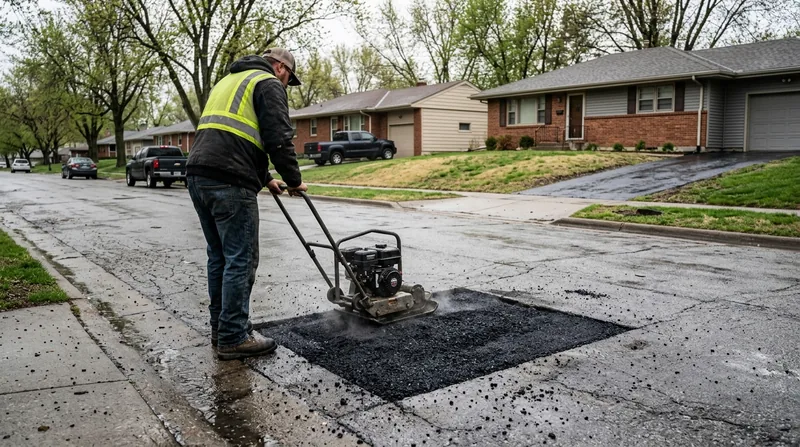




Pothole Repair & Asphalt Patching in Omaha is the fastest way to stop a small failure before it spreads into the base and costs thousands in full replacement. Omaha's freeze-thaw cycle and heavy spring meltwater create ideal conditions for potholes to open fast. Once water sits under a thin asphalt layer, the loess subgrade softens and the base loses strength, and a small crack becomes a crater in weeks. We saw-cut the damaged spot, remove the failed material down to solid ground, and pack new hot mix flush with the surrounding surface. The work is straightforward, the cost is low compared to resurfacing or replacement, and catching a pothole early keeps your driveway durable for years.
Why Potholes Form Fast in Omaha's Climate and Soil
Greater Omaha's geology and weather are the two forces behind pothole growth. The region sits on wind-blown loess, a silt-rich soil that drains poorly and loses strength when saturated. Beneath that loess lies clay-rich glacial till that holds water against the asphalt base year-round, especially on sloped lots in the bluffs above the Missouri River and in the older streetcar neighborhoods. When meltwater or heavy spring rain sits under the asphalt, the loess softens, the base settles unevenly, and the asphalt cracks. Plow blades on aprons and driveway edges in winter make the damage worse, and freeze-thaw cycles widen cracks into open potholes by late March and April.
- Water trapped under a thin base migrates downward and softens the subgrade, causing the asphalt to flex and crack.
- Freeze-thaw cycles expand ice in the base and push the slab upward, then thaw and settle unevenly, opening gaps and alligator cracking.
- Plow blades strike the edges of aprons and driveway perimeters, breaking the asphalt and allowing water to seep into the base.
- Small cracks become potholes within weeks once traffic loads the weak spot, spalling the asphalt edges and widening the hole.
Catching a pothole while it is still a crack saves money and keeps your driveway safe for foot traffic and vehicles.
Local example: A driveway in Ralston with a north-facing apron and poor drainage developed a hairline crack in early March. By mid-April, freeze-thaw cycles had widened it into a 4-inch pothole. A $500 patch sealed the failure and extended the driveway life by five years. Had the homeowner waited until summer, the base would have failed and full resurfacing would have cost $3,500.
For detailed guidance on all driveway repair options in Omaha, visit our Driveway Repair page.
How We Repair Potholes and Patches in Omaha Driveways
Our pothole repair process starts with a careful removal of the failed asphalt and base material. We use a saw to cut a clean edge around the damaged area, then excavate down to the solid loess subgrade or the intact base layer below. Once the hole is clean and dry, we compact new aggregate base if needed, then place and tamp hot mix asphalt in lifts until the patch is flush with the surrounding surface. The patch cures for 24 to 48 hours before the driveway is ready for normal traffic. The work is fast, the cost is predictable, and a solid patch holds for years if the base is sound.
- We saw-cut a clean perimeter around the damaged area to expose intact asphalt and prevent the patch from raveling at the edges.
- We remove all failed asphalt, softened base material, and debris down to the original subgrade or a sound base layer.
- We inspect the subgrade for standing water and improve drainage if the hole is in a low spot where water collects.
- We compact new aggregate base to the proper density and grade, then place hot mix asphalt in two or more lifts depending on patch depth.
- We tamp and finish the final lift level with the surrounding asphalt, creating a smooth, safe surface ready for traffic.
The entire job typically takes one to three hours depending on patch size and how deep the failure runs.
Omaha example: A residential driveway in Bellevue had three separate potholes caused by poor drainage under the asphalt. We patched all three in one visit, improved the slope at the garage apron to move water away from the slab, and the patches have held solid for four years with no edge failure or raveling.
To learn more about when patching makes sense versus full resurfacing, see our Asphalt Resurfacing & Overlay page.
Pothole Repair & Asphalt Patching Methods: When Each Approach Works Best
| Repair Method | Description | Best For |
|---|---|---|
| Cold-Patch Temporary Repair | Pre-bagged asphalt mix applied to a cleaned pothole without heat or compaction, used only as emergency or very short-term fix. | Emergency temporary repairs or parking lots where traffic is light; not recommended for residential driveways. |
| Hot Mix Saw-Cut Patch | Clean saw-cut perimeter, full excavation to subgrade, compacted base, and tamped hot mix asphalt placed in lifts and finished flush with surrounding surface. | Single or multiple potholes in otherwise sound driveways; the standard repair method for Omaha residential work. |
| Full-Depth Patch (Removal and Replacement) | Removal of asphalt and base down to the subgrade, replacement of the entire section with new base and asphalt, then compaction and finishing. | Large potholes or areas where the base has failed completely; more expensive than standard patching but necessary when damage is deep. |
| Seal-and-Fill Crack Repair | Small hairline cracks cleaned, dried, and filled with rubberized crack sealant to prevent water infiltration before the crack becomes a pothole. | Early-stage cracks and minor surface damage; preventive work that stops potholes before they form. |
A pothole repair that is done correctly with a clean saw cut, proper base compaction, and hot mix asphalt will hold for five to ten years if the surrounding driveway is sound and drainage is adequate. If alligator cracking or multiple potholes appear across thirty to forty percent of the surface, patching throws money away and the driveway needs resurfacing or replacement.
Pothole Repair & Asphalt Patching Cost in Omaha: What to Expect
A typical pothole repair in Omaha starts at $450 and covers a single patch up to roughly 20 square feet, including saw-cutting, excavation, base preparation, and hot mix asphalt placed and finished flush with the surrounding surface. The cost depends on the size and depth of the pothole, the condition of the base underneath, whether new aggregate base is needed, and how far the excavation must go to reach solid ground. Multiple potholes on the same driveway are often repaired in one visit, which reduces the per-patch cost and the total service fee. A driveway with three or four small potholes may cost $700 to $1,200 total, while a large pothole or one requiring significant base replacement can run $800 to $1,500 for that single repair.
The best way to know the real cost for your driveway is to get a free written estimate. We measure the damage on site, inspect the base and drainage, and quote the work in tonnage and square footage so you know exactly what you are paying for. Comparing two or three estimates from different contractors gives you confidence in the price and helps you spot the red flags of a scam: no written estimate, a price that seems too good, no mention of thickness or tonnage, or pressure to pay a large cash deposit upfront.
For a full pricing overview and details on other asphalt services, see our Pricing page.
What to Look for When Hiring a Pothole Repair Contractor Near Me in Omaha
The strongest trust signal in asphalt paving is local presence and verifiable history. Any contractor offering pothole repair and patching in Omaha should be able to show you a local address, local phone number, and a track record of work in the area. Ask for references from recent jobs in your neighborhood, and call them to ask about the quality of the patch, how long it has held, and whether the contractor was professional and punctual. Get a written estimate that includes the depth of the patch, the tonnage of asphalt, and the labor cost, so you can compare apples to apples with other bids.
- Verify that any contractor you hire is fully insured for liability and property damage, and ask to see the certificate before work begins.
- Check that the estimate is written, specific to your driveway, and includes the square footage of the patch and the tonnage of materials.
- Ask whether the contractor has done similar work in your city or neighborhood, and request references you can call to verify quality and durability.
- Understand that Nebraska requires contractor registration with the state before construction work begins, and that the City of Lincoln requires its own permit and bond for right-of-way work at the street line.
- Avoid unsolicited door-to-door offers, large cash deposits upfront, contractors with out-of-state plates, or prices that sound too good to be true.
A reputable paving contractor will be happy to answer your questions, provide references, and explain the work in detail before you commit.
Ready to get started? Contact us for a free estimate at (402) 807-2119.
Pothole Repair & Asphalt Patching in Omaha: Pricing Guide
| Service | Price | Details |
|---|---|---|
| Single pothole patch | Starting at $450 | Includes saw-cut perimeter, excavation to subgrade, new base if needed, and hot mix asphalt finished flush with surface |
| Multiple potholes (2-4 patches) | Starting at $700 | Repaired in one visit; per-patch cost decreases with volume, and drainage improvements can be included to prevent future failure |
| Large pothole or full-depth patch | Starting at $800 | Deeper excavation, more base material, or extensive subgrade preparation; final cost depends on size and condition of damaged area |
| Driveway inspection and damage assessment | Free | On-site visit to evaluate potholes, base condition, drainage issues, and determine whether patching or resurfacing is the right choice |
| Written estimate | Free | Detailed quote with tonnage, square footage, and labor cost; response within 24 hours at (402) 807-2119, no obligation to book |
Indicative pricing, the exact cost depends on square footage, finish, and site access. Free personalized estimate within 24h at (402) 807-2119.


